Why Windmaster Whirlybirds Are Popular in Australian Homes
When Australian homeowners look for a simple way to reduce roof heat and improve airflow, whirlybirds are often the first option they consider. Among them, Windmaster whirlybirds are widely recognised for their solid build quality and long-standing presence in the local market.
They appeal because they are:
- Wind-driven
- Low maintenance
- Free to run
However, while Windmaster whirlybirds can help in certain conditions, understanding how they actually work is essential before assuming they are the right solution for hot roof spaces or condensation issues.
What Is a Windmaster Whirlybird?
A Windmaster whirlybird is a passive roof ventilation system. It sits on the roof and spins when wind passes through its turbine head. As it spins, it helps draw warm air out of the roof cavity.
Unlike powered systems, a Windmaster whirlybird:
- Uses no electricity
- Has no motor or fan
- Relies entirely on natural wind movement
This design makes it simple and durable — but also defines its limitations.
How a Windmaster Whirlybird Works in Roof Spaces
Windmaster whirlybirds assist ventilation in two ways:
- When wind is present, the turbine spins, helping extract warm air
- When roof space heat builds up, hot air rises and exits through the ventilator via thermal convection
This means whirlybirds can still provide some airflow even with minimal wind, as long as there is sufficient heat buildup in the roof space.
However, the airflow rate remains uncontrolled and variable, as it depends entirely on environmental conditions rather than active extraction.
However, when the wind drops — which is common during hot Australian afternoons — airflow drops with it.
Benefits of Windmaster Whirlybirds
To be fair, Windmaster whirlybirds do offer genuine advantages:
- No running costs – once installed, they cost nothing to operate
- Simple mechanical design – fewer parts to fail
- Weather-resistant construction – built for Australian conditions
- Helpful in mild conditions – especially where consistent wind is present
For homeowners with modest ventilation needs, these benefits can be sufficient.
The Limitations of Passive Whirlybird Ventilation
This is where expectations and reality often diverge.
Performance Depends on Weather Conditions
While whirlybirds can work via heat convection, their overall performance still depends heavily on environmental factors.
On still, hot days:
- Wind-driven rotation is minimal
- Thermal convection alone provides limited airflow
- Heat can remain trapped for long periods
Unfortunately, these conditions often coincide with peak roof temperatures.
Limited Control Over Moisture and Condensation
Condensation forms when warm, moist air meets cooler roof surfaces — commonly overnight or during colder months.
Passive whirlybirds:
- Do not respond to humidity levels
- Cannot increase airflow on demand
- Rely on natural convection, which may be insufficient in cool or still conditions
As a result, moisture can linger in roof cavities, contributing to:
- Damp insulation
- Timber deterioration
- Increased mould risk
Installation Is Limited by Roof Type and Pitch
Another often-overlooked limitation is where whirlybirds can be installed.
Windmaster whirlybirds are typically suitable only for:
- Tiled roofs
- Metal roofs
- Roof pitches roughly between 3° and 45°
This means they may not be appropriate for:
- Certain architectural roof designs
- Structures where correct levelling is difficult
If installed outside recommended conditions, performance and longevity can be affected.
Not Always Enough for Hot Roof Spaces
Certain roof designs place a higher demand on ventilation:
- Dark-coloured roofs
- Low-pitch roofs within the allowable range
- Limited eave or cross-ventilation
In these scenarios, heat loads can exceed what passive ventilation — even with thermal convection — can realistically handle.
Why Some Homeowners Look Beyond Windmaster Whirlybirds
Windmaster whirlybirds are not faulty products — they work exactly as passive systems are designed to work. The issue arises when homeowners expect them to deliver consistent performance regardless of conditions.
Many people only realise the limitations after noticing:
- Roof spaces still overheating
- Ongoing condensation problems
- Minimal airflow during calm weather
At that point, the conversation shifts from brand choice to ventilation type.
Passive vs Powered Roof Ventilation: What’s the Difference?
Understanding this distinction is key.
Passive ventilation:
- Depends on wind and temperature differences
- Offers variable airflow
- Cannot respond to temperature or humidity changes
Powered roof ventilation:
- Actively extracts air using a fan
- Delivers consistent airflow
- Better suited to managing heat and moisture consistently
This difference explains why some homes need more than a whirlybird — regardless of brand.
When a Windmaster Whirlybird Alternative Makes Sense
For homeowners dealing with persistent heat build-up or condensation, passive ventilation may no longer be sufficient.
For those looking beyond passive ventilation, here’s a Windmaster whirlybird alternative that explains when powered roof ventilation becomes the more effective option for heat and moisture control.
This approach helps match the right ventilation type to the actual roof conditions.
A Brief Look at Powered Solar Roof Ventilation
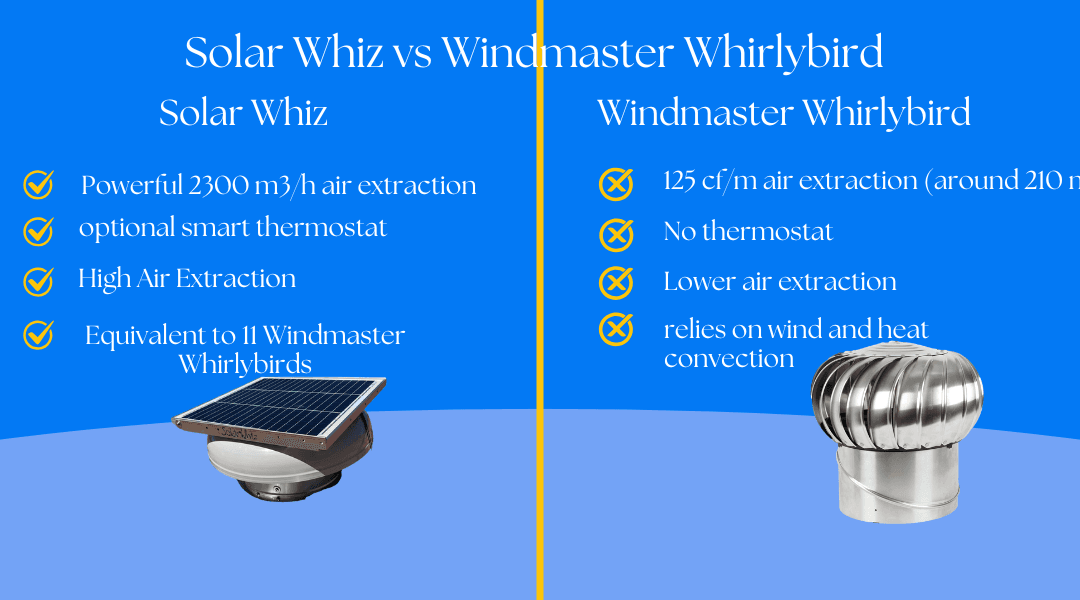
Powered systems introduce controlled airflow into the equation. Solutions such as Solar Whiz use solar energy to actively extract hot and moist air from roof spaces.
Key differences include:
- Consistent airflow even on still days
- Active heat extraction
- Better suitability for condensation-prone homes
- Optional controls for temperature and moisture management
This doesn’t replace whirlybirds in every situation — but it explains why many homeowners upgrade when passive ventilation falls short.
Conclusion: Choosing the Right Roof Ventilation for Your Home
Windmaster whirlybirds remain a reliable passive ventilation option. They work using both wind-driven rotation and heat convection, but they are still entirely condition-dependent.
The real question isn’t whether Windmaster is a good brand — it’s whether passive ventilation alone is enough for your roof design, climate, and moisture levels.
Could a powered Windmaster whirlybird alternative provide better heat and moisture control for your home?